
Are you unsure whether an impact crusher or jaw crusher is the right choice for your crushing operation? This is a common question for engineers, contractors, and plant operators across Saudi Arabia, especially in industries like mining, construction, and aggregate production.
Choosing the right crusher is critical—not just for performance, but also for efficiency, maintenance costs, and final product quality. In this guide, we’ll break down the key differences between impact crushers and jaw crushers to help you make an informed decision.
What is a Jaw Crusher?
A jaw crusher is a primary crushing machine that uses compressive force to break large materials into smaller pieces.
How It Works
It consists of two plates:
- One fixed jaw
- One moving jaw
The material is crushed as the moving jaw presses it against the fixed jaw.
Key Features
- Ideal for primary crushing
- Handles large and hard materials
- Simple structure and reliable operation
- Low maintenance requirements
Jaw crushers are commonly used for crushing granite, basalt, limestone, and other hard rocks.
What is an Impact Crusher?
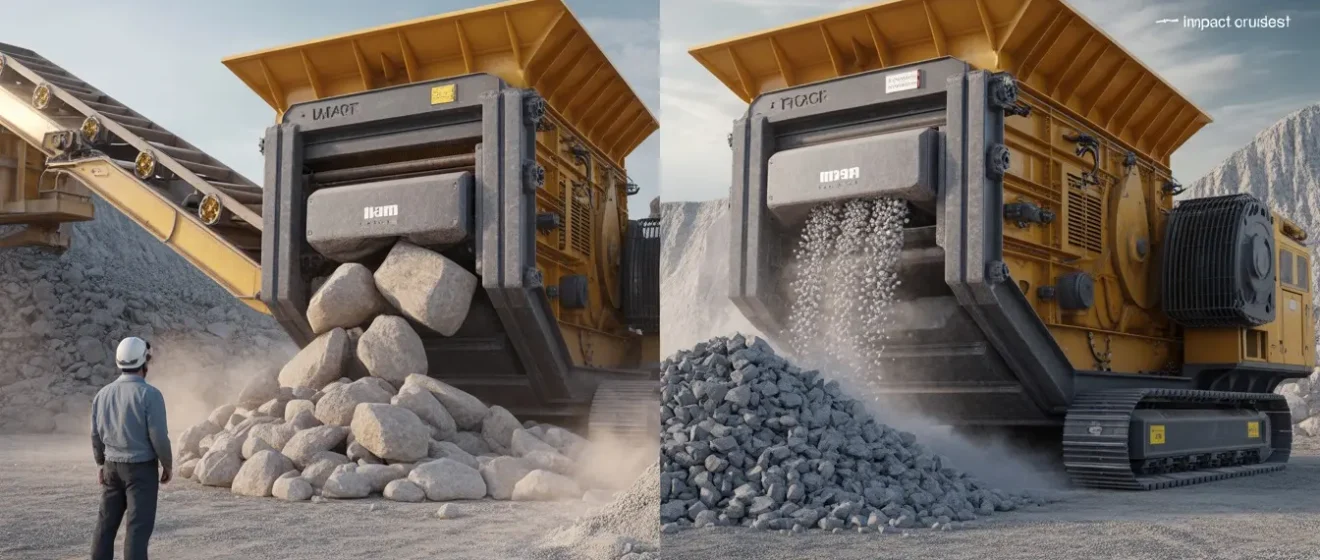
An impact crusher uses high-speed impact force to break materials into smaller pieces.
How It Works
Material is fed into the crusher and hit by fast-rotating blow bars or hammers. The material breaks upon impact and is further reduced as it hits the crusher walls.
Key Features
- Suitable for secondary or tertiary crushing
- Produces finer, more uniform material
- High-speed operation
- Better for softer to medium-hard materials
Impact crushers are widely used for producing high-quality aggregates.
Impact Crusher vs Jaw Crusher: Key Differences
Understanding the differences between these two machines is essential for selecting the right equipment.
1. Crushing Principle
- Jaw Crusher: Uses compression force
- Impact Crusher: Uses impact force
Jaw crushers crush material by squeezing, while impact crushers break it by striking.
2. Application Stage
- Jaw Crusher: Primary crushing
- Impact Crusher: Secondary or tertiary crushing
Jaw crushers are typically the first step in the crushing process, while impact crushers refine the material further.
3. Material Hardness
- Jaw Crusher: Best for hard and abrasive materials
- Impact Crusher: Best for soft to medium-hard materials
For tough rocks like granite or basalt, jaw crushers are more suitable. Impact crushers work better with limestone and recycled materials.
4. Output Size and Shape
- Jaw Crusher: Produces rough, uneven particles
- Impact Crusher: Produces uniform, cubical shapes
If your project requires high-quality aggregates, an impact crusher is usually the better option.
5. Maintenance and Wear
- Jaw Crusher: Lower wear and longer lifespan
- Impact Crusher: Higher wear due to high-speed impact
Impact crushers require more frequent replacement of wear parts like blow bars.
6. Energy Efficiency
- Jaw Crusher: More energy-efficient for primary crushing
- Impact Crusher: Consumes more energy but delivers finer output
Energy consumption depends on the application, but jaw crushers are generally more efficient for large material reduction.
7. Cost Considerations
- Jaw Crusher: Lower operating and maintenance costs
- Impact Crusher: Higher maintenance but better product quality
The total cost depends on your production goals and material requirements.
When Should You Use a Jaw Crusher?
A jaw crusher is the right choice when:
- You need primary crushing
- You are working with hard or abrasive materials
- You want a simple and durable machine
- You require low maintenance
It is commonly used in quarrying, mining, and heavy construction projects.
When Should You Use an Impact Crusher?
An impact crusher is ideal when:
- You need finer material output
- You want uniform, cubical aggregates
- You are working with softer materials
- You require secondary or tertiary crushing
It is widely used in road construction, recycling, and aggregate production.
Choosing the Right Crusher for Your Project
In many cases, both crushers are used together:
- Jaw Crusher for primary crushing
- Impact Crusher for secondary shaping
This combination ensures efficient processing and high-quality output.
For industrial operations in Saudi Arabia, selecting the right equipment depends on:
- Material type
- Production capacity
- Desired output size
- Budget and maintenance considerations
Conclusion
Understanding the difference between an impact crusher and a jaw crusher is essential for optimizing your crushing operations. Jaw crushers are powerful, reliable, and ideal for handling hard materials in primary stages, while impact crushers excel at producing fine, uniform aggregates in later stages.
By choosing the right crusher—or combining both—you can improve efficiency, reduce costs, and achieve better production results.
For high-quality crusher parts and industrial solutions, Contact RoadTRD to keep your plant running efficiently.
Frequently Asked Questions
1. Which is better: jaw crusher or impact crusher?
It depends on the application—jaw crushers are better for hard materials, while impact crushers are ideal for finer output.
2. Can both crushers be used together?
Yes, they are often used in combination for better results.
3. Which crusher produces better aggregate shape?
Impact crushers produce more uniform and cubical aggregates.
4. Are jaw crushers more durable?
Yes, they generally have lower wear and longer lifespan.
5. Which crusher requires more maintenance?
Impact crushers require more maintenance due to wear parts.
Call to Action
Looking for reliable crusher parts and industrial solutions in Saudi Arabia? Explore premium-quality equipment and expert support at RoadTRD—your trusted partner for efficient crushing operations.