Industrial valves play a critical role in maintaining efficient and controlled operations across manufacturing plants, asphalt production facilities, concrete plants, industrial processing units, and fluid-handling systems. From controlling the movement of liquids and gases to isolating equipment during maintenance, these components are essential for industrial performance and operational safety.
In Saudi Arabia, industrial facilities operate under diverse conditions, including high ambient temperatures, demanding production schedules, and continuous equipment usage. Selecting the right industrial valve is therefore an important decision for maintenance engineers, plant operators, and procurement teams.
However, not all industrial valves perform the same function. Different applications require specific valve designs, materials, pressure ratings, and control mechanisms.
This guide explains the different types of industrial valves, their applications, common operational problems, maintenance requirements, and key factors to consider when selecting industrial valves in Saudi Arabia.
1. Understanding Industrial Valves and Their Importance
An industrial valve is a mechanical device designed to control, direct, regulate, or stop the flow of liquids, gases, and other process media within a system.
Valves are used throughout industrial equipment and piping networks to perform several essential functions.
These include:
- Starting or stopping fluid flow
- Regulating flow rates
- Isolating equipment during maintenance
- Controlling process operations
- Supporting automated industrial systems
- Managing fluid distribution through pipelines
The correct valve selection depends on the application and the conditions under which the equipment operates.
For example, a valve used in a compressed-air system may have completely different operating requirements from one installed in a heated bitumen transfer line.
Using a valve that is not compatible with the operating medium, pressure, or temperature can result in leakage, premature component failure, and operational interruptions.
For this reason, industrial valve selection should always be based on technical compatibility rather than appearance or size alone.
2. Common Types of Industrial Valves and Their Applications
Industrial facilities use several types of valves depending on the required flow-control function.
Understanding their differences helps engineers and purchasing teams identify suitable components.
Gate Valves
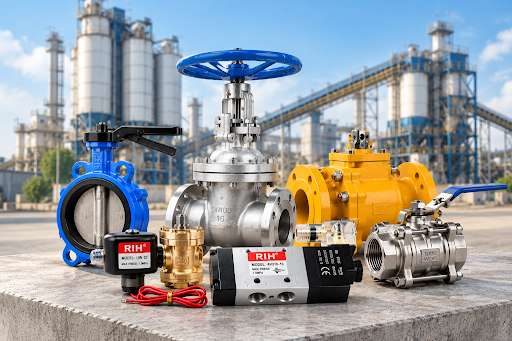
Gate valves are commonly used in industrial piping systems where the main requirement is to allow or stop flow.
These valves operate by moving a gate or wedge into or out of the flow path.
When fully opened, the valve generally allows fluid to pass through with relatively little obstruction.
Common applications include:
- Industrial water distribution systems
- Pipeline isolation
- Utility services
- General fluid-transfer operations
- Equipment maintenance isolation
Gate valves are generally intended for fully open or fully closed operation rather than continuous flow throttling.
When selecting a gate valve, it is important to verify its material, connection type, pressure rating, and compatibility with the fluid being handled.
Butterfly Valves
Butterfly valves use a rotating disc positioned within the flow path.
The disc turns to open, restrict, or close the passage, making butterfly valves a practical option for many industrial piping systems.
Their relatively compact design can be useful where installation space is limited.
Typical applications include:
- Industrial water systems
- Process pipelines
- Manufacturing facilities
- Material-handling equipment
- Automated flow-control systems
Butterfly valves may be operated manually or through suitable actuators.
The choice depends on the required level of automation, valve size, operating conditions, and system design.
Solenoid Valves
Solenoid valves are electrically operated devices used to control the flow of liquids or gases.
An electrical signal activates a solenoid mechanism, changing the valve’s operating position.
These valves are widely used in industrial automation because they allow flow-control functions to be integrated with electrical control systems.
Common applications include:
- Pneumatic systems
- Automated industrial equipment
- Compressed-air control
- Industrial machinery
- Process-control arrangements
Different solenoid valves are designed for different operating media and conditions.
For example, a valve intended for compressed air should not automatically be assumed suitable for hot oil or other liquids.
Before purchasing a solenoid valve, operators should check its voltage, pressure range, connection size, operating mode, and media compatibility.
Ball Valves
Ball valves contain a rotating ball with an opening through its center.
When the opening aligns with the pipeline, fluid can pass through. Rotating the ball changes the flow path and allows the valve to close.
Ball valves are commonly selected for applications requiring straightforward shut-off operation.
Typical applications include:
- Industrial fluid pipelines
- Equipment isolation
- Water and utility services
- Oil-handling systems, where compatible
- General industrial processes
The valve’s internal materials, seals, and operating ratings determine whether it is suitable for a particular application.
Bitumen Jacketed Valves
Bitumen-handling systems require special consideration because bitumen viscosity changes significantly with temperature.
When bitumen cools, its resistance to flow increases, potentially affecting pumping, transfer, and processing operations.
Jacketed valves are designed with arrangements that can support heating around the valve body when integrated into a suitable heating system.
These valves may be used in heated bitumen processing and transfer applications.
Important selection considerations include:
- Operating temperature
- Heating-medium compatibility
- Valve body construction
- Seal and gasket materials
- Connection requirements
- Required flow direction
ROAD Engineering Trading Est. lists bitumen jacketed valve configurations within its industrial valves range.
The exact suitability of each model should be confirmed against the equipment and process requirements.
3. Industrial Valve Applications in Saudi Arabia
Industrial valves are used across multiple sectors where the movement of fluids or gases must be controlled.
Asphalt Production Plants
Asphalt plants contain different mechanical and process systems that require appropriate flow-control components.
Depending on plant configuration, valves may be used in bitumen handling, heating circuits, compressed-air arrangements, and other fluid-transfer systems.
Because asphalt production often involves elevated operating temperatures, valve material compatibility and temperature ratings are particularly important.
Selecting an unsuitable component can interfere with process operation and increase maintenance requirements.
Concrete Batching Plants
Concrete batching plants use a combination of mechanical, pneumatic, and automated equipment.
Valves may be involved in compressed-air systems, water distribution, and other process-control arrangements.
Their selection depends on the specific equipment design and the media being handled.
Industrial Manufacturing Facilities
Manufacturing operations frequently depend on controlled fluid and gas distribution.
Valves may be installed in production lines, process equipment, utility networks, and automated machinery.
Reliable operation depends on selecting components appropriate for the intended duty.
Pneumatic Automation Systems
Pneumatic systems use compressed air to operate equipment such as cylinders, actuators, and other control devices.
Solenoid valves and directional control valves are commonly used to manage air movement within these systems.
Valve selection must account for operating pressure, airflow requirements, electrical specifications, and connection compatibility.
4. How to Choose the Right Industrial Valve
Selecting an industrial valve involves more than matching the diameter of an existing component.
Several technical factors should be evaluated before ordering.
Identify the Operating Medium
The first step is determining what will pass through the valve.
Examples include:
- Water
- Compressed air
- Oil
- Heated bitumen
- Other industrial fluids or gases
Different media may require different materials, seals, and valve designs.
Confirm Pressure Requirements
Every valve has operating pressure limitations.
The selected component must be suitable for the actual system pressure, including relevant operating variations.
A valve with an insufficient pressure rating may present operational and safety risks.
Check Temperature Compatibility
Temperature is especially important in industrial heating and bitumen-handling applications.
High temperatures can affect seals, gaskets, and other valve components.
Always review the manufacturer’s operating temperature limits.
Verify Valve Size and Connection Type
Correct sizing is essential for compatibility with existing piping and equipment.
Important details may include:
- Nominal diameter
- Threaded or flanged connections
- Connection standards
- Installation dimensions
- Required flow capacity
A physically similar valve may still have incompatible connections or operating characteristics.
Choose Manual or Automated Operation
Manual valves are operated directly by personnel.
Automated valves use suitable electric, pneumatic, or other actuation systems.
The appropriate choice depends on how frequently the valve must operate and how the industrial process is controlled.
Review Material and Seal Compatibility
Valve body and sealing materials should be compatible with the operating medium and conditions.
For demanding applications, procurement teams should consult equipment specifications and manufacturer documentation before selecting a replacement.
5. Common Industrial Valve Problems
Even properly selected valves can develop problems over time due to operating conditions, contamination, wear, or maintenance issues.
Understanding common symptoms can help maintenance teams identify when inspection is necessary.
Valve Leakage
Leakage may occur around connections, seals, or internal closing surfaces.
Possible contributing factors include worn seals, improper installation, damaged components, or operating conditions beyond the valve’s rated limits.
The cause should be identified before replacing individual parts.
Difficulty Opening or Closing
A valve that becomes difficult to operate may be affected by internal deposits, corrosion, mechanical damage, or actuator-related issues.
Operators should avoid forcing a valve without understanding the cause, particularly in pressurized or high-temperature systems.
Solenoid Valve Malfunction
An electrically operated valve may fail to respond because of electrical supply problems, coil faults, contamination, or mechanical issues.
Inspection should include the relevant electrical and mechanical checks performed under safe maintenance procedures.
Unexpected Flow Restrictions
Reduced flow may result from valve positioning, internal obstruction, incorrect sizing, or other system conditions.
The valve should be assessed as part of the complete process system rather than assuming it is the only source of the problem.
Premature Component Wear
Repeated operation under unsuitable pressure, temperature, or media conditions may shorten component service life.
Reviewing the actual operating environment can help determine whether a different valve specification is required.
6. Industrial Valve Maintenance Best Practices
A structured maintenance approach can help reduce unexpected interruptions and identify developing problems.
Perform routine visual inspections. Check accessible valve surfaces and connections for signs of leakage, corrosion, or damage.
Monitor operating behavior. Unusual noise, slow response, or inconsistent operation may indicate a problem requiring investigation.
Follow manufacturer maintenance instructions. Inspection intervals and servicing procedures vary according to valve design and operating conditions.
Maintain suitable operating conditions. Ensure that system pressure, temperature, and media remain within the valve’s specified limits.
Use compatible replacement components. Seals, coils, actuators, and other parts should match the relevant valve model and application.
Maintain accurate equipment records. Recording valve specifications, maintenance history, and replacement dates can support more efficient procurement and servicing.
Before performing maintenance, equipment should be isolated, depressurized, and made safe in accordance with the applicable site procedures.
7. Why Correct Valve Selection Supports Operational Efficiency
The right industrial valve contributes to more predictable system operation.
When a valve matches the process requirements, it can support consistent flow control, effective isolation, and appropriate integration with the equipment.
Conversely, incorrect selection may lead to repeated replacement, leakage, installation difficulties, and production interruptions.
For maintenance and procurement teams, it is therefore useful to consider the total operating requirements rather than focusing only on the initial purchase price.
Technical compatibility, availability of suitable replacement parts, and ease of maintenance are important considerations in industrial purchasing decisions.
8. Industrial Valves Available Through ROAD Engineering Trading Est.
ROAD Engineering Trading Est. provides industrial spare parts and equipment components for industrial applications in Saudi Arabia.
Its industrial valves category includes several types of valves used for different flow-control requirements.
These include:
- Gate valves
- Butterfly valves
- Solenoid valves
- Ball valves
- Bitumen jacketed valves
- Other industrial valve components
Product availability and exact specifications should be confirmed through the relevant product listings.
Explore Industrial Valves:
ROAD Engineering Trading Est.
Website: https://roadtrd.com/
Contact: +966 55 076 4440
9. Frequently Asked Questions About Industrial Valves
What are industrial valves used for?
Industrial valves are used to control, regulate, direct, or isolate the flow of liquids and gases in industrial systems.
Which industrial valves are commonly used in automation?
Solenoid valves and actuator-operated valves are frequently used in automated systems. Their suitability depends on the process and control requirements.
What is the difference between a gate valve and a butterfly valve?
A gate valve typically uses a moving gate to open or close the flow path, while a butterfly valve uses a rotating disc. Their suitability depends on the application, operating conditions, and control requirements.
Which valves are suitable for asphalt plants?
Asphalt plants may use several valve types, including valves for heated bitumen, oil circuits, and pneumatic systems. The appropriate model depends on the particular equipment and operating medium.
How do I choose the correct replacement valve?
Review the existing valve’s type, model, dimensions, connection standard, pressure rating, temperature limits, media compatibility, and operating mechanism.
Can one industrial valve be used for different fluids?
Only when the valve manufacturer’s specifications confirm compatibility with those fluids and the intended operating conditions.
Where can businesses explore industrial valves in Saudi Arabia?
Businesses can review ROAD Engineering Trading Est.’s industrial valves category to explore available valve types and product listings.